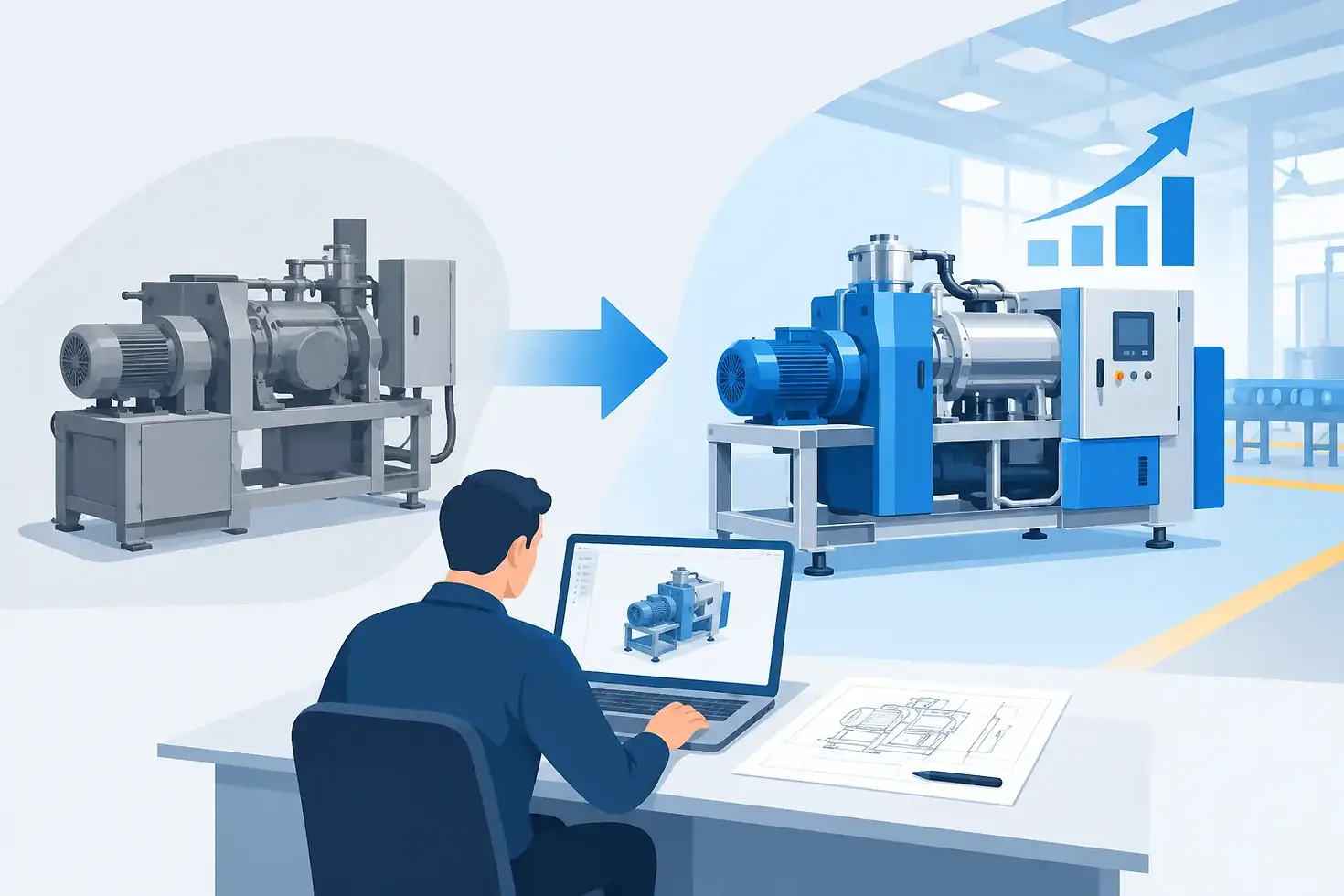
Industrial Equipment Redesign Services That Scale
A machine can remain productive long after its original design assumptions have stopped serving the operation. Components become difficult to source, maintenance intervals tighten, throughput targets rise, or safety expectations change. Industrial equipment redesign services address these practical constraints by turning existing machinery, assemblies, and production systems into validated, manufacturable solutions built for current operating conditions.
The goal is not to replace a machine simply because it is old. Effective redesign identifies the specific factors limiting performance, then applies precision modeling, engineering analysis, prototype validation, and production planning to correct them. For manufacturers, this can preserve valuable capital equipment while improving reliability, operator safety, serviceability, and lifecycle cost.
When Industrial Equipment Redesign Services Are Needed
Redesign projects often begin with a visible failure: a cracked bracket, repeated bearing damage, overheating enclosure, excessive vibration, or an assembly that is no longer practical to build. The underlying issue is frequently broader than the failed part. A bracket may crack because the load path is poorly controlled. Bearings may fail early because shaft alignment, lubrication access, or thermal expansion was not adequately considered. An obsolete fabricated assembly may be expensive because its tolerances and weld sequence do not match the capabilities of the current supplier base.
Industrial equipment redesign services provide a disciplined way to examine the complete mechanical system rather than treating each symptom as an isolated repair. This is especially valuable when original drawings are incomplete, the equipment has been modified over years of use, or critical knowledge exists only with a few experienced operators and maintenance personnel.
A redesign may be appropriate when equipment is creating recurring downtime, cannot meet a new production rate, presents an ergonomic or guarding concern, relies on obsolete components, or produces inconsistent product quality. It can also support a planned manufacturing expansion when a proven concept needs to operate at higher duty cycles or in a more demanding environment.
The right scope depends on the problem. Some projects require a focused redesign of a high-wear subsystem. Others require a full mechanical reconfiguration involving structure, drives, heat transfer, controls interfaces, tooling, and installation planning. Defining that boundary early prevents unnecessary engineering effort while ensuring that interdependent risks are not missed.
Start With the Actual Operating Condition
A productive redesign effort begins on the plant floor, not only in the CAD environment. Design teams need a clear view of how equipment is actually used: loads, duty cycles, material flow, operator interaction, maintenance procedures, ambient temperature, contamination exposure, and the conditions surrounding a failure.
This information is often different from the original design intent. A conveyor may now carry heavier product. A fixture may be loaded by a different part family. A process skid may operate longer shifts with less cooldown time. Even small operational changes can alter fatigue life, heat buildup, deflection, or required factor of safety.
The engineering team should combine site observations, maintenance records, operator input, photographs, available drawings, and physical measurements into a usable design basis. Where documentation is missing or unreliable, reverse engineering establishes an accurate digital representation of the installed condition. High-quality 3D CAD models provide the foundation for evaluating fit, clearances, interfaces, and proposed modifications before fabrication begins.
This discovery phase should also identify what must remain unchanged. Existing floor anchors, electrical connections, process piping, access envelopes, and adjacent equipment can impose legitimate constraints. A technically sound redesign that requires extensive unplanned plant modifications may not be the best business decision.
Analyze the Cause, Not Just the Symptom
The value of redesign engineering comes from validating decisions before material is cut. Structural analysis can assess stress concentrations, deflection, buckling risk, fatigue exposure, and load transfer through frames, brackets, shafts, and supports. Thermal analysis can identify heat accumulation, insufficient cooling, material expansion concerns, or conditions that reduce component life.
For moving equipment, the mechanical review may also evaluate motion profiles, inertia, drive sizing, bearing loads, vibration, alignment, and guarding. A good redesign considers the whole load path from the point of applied force through the supporting structure and into the facility interface.
Analysis should be proportionate to the risk. A simple low-load guard modification may only require careful modeling and design review. A large welded framework, elevated platform, pressure-related component, or high-cycle automated mechanism may require more formal calculations and detailed validation. The objective is not analysis for its own sake. It is to make design choices with sufficient engineering confidence.
There are trade-offs in nearly every redesign. Increasing plate thickness may reduce stress but add weight and complicate handling. A stronger material may increase cost or lead time. Tighter tolerances can improve alignment but may make fabrication more difficult. The best solution balances performance with procurement, fabrication, installation, and long-term maintenance realities.
Design for Fabrication, Service, and Scale
A redesign is only complete when it can be built and maintained consistently. Manufacturing-ready CAD documentation should communicate dimensions, tolerances, materials, finishes, welding requirements, purchased components, and assembly intent without forcing fabricators to fill gaps through assumptions.
Design for manufacturability often produces significant improvements without changing the equipment's core function. Consolidating parts, standardizing fasteners, simplifying weldments, using readily available profiles, improving tool access, and reducing unnecessary precision can lower fabrication cost and shorten lead times. In other cases, a more sophisticated assembly is justified because it improves repeatability, protects product quality, or reduces failure exposure.
Serviceability deserves equal attention. Maintenance teams need clear access to belts, bearings, sensors, filters, fasteners, lubrication points, and wear components. A redesign that extends component life but requires hours of disassembly for routine service can shift cost from downtime caused by failure to downtime caused by maintenance.
For equipment that will be reproduced across multiple lines or facilities, standardization becomes essential. Common components, modular subassemblies, controlled revision documentation, and defined acceptance criteria reduce variation during future builds. This is where redesign becomes a platform for scalable manufacturing rather than a one-time repair.
Validate Before Full-Scale Manufacturing Rollout
High-fidelity functional prototypes, pilot assemblies, or targeted mockups give teams an opportunity to verify fit and function under real-world conditions. The form of validation depends on the project. A redesigned frame may require a fit-up inspection and load test. A thermal enclosure may need temperature measurements at expected duty. A fixture may need repeated operator trials to confirm cycle time, accessibility, and part location accuracy.
Prototype iteration is particularly valuable when equipment interfaces with variable materials, manually handled parts, or legacy systems that cannot be fully characterized from drawings. It reveals interference issues, installation challenges, and operator concerns before they become expensive field changes.
The final production package should support a controlled handoff to fabrication and installation. That typically includes released models and drawings, bills of materials, critical assembly requirements, inspection points, and a plan for testing or commissioning. For complex projects, project management coordinates suppliers, fabrication milestones, design revisions, and site readiness so that engineering changes do not disrupt the manufacturing schedule.
Redesign as an Operational Investment
Equipment redesign should be evaluated against operational outcomes, not only the price of new components. The relevant measures may include reduced downtime, lower maintenance labor, higher throughput, improved yield, safer access, reduced energy use, and less dependence on obsolete parts. The strongest business case usually combines several of these gains.
There is also a timing decision. Waiting until a repeated failure forces an emergency response, restricted design choices, and expedited purchasing. Planning a redesign around a scheduled shutdown allows time for analysis, prototype iteration, supplier coordination, and installation preparation. That typically produces a more controlled result and reduces interruption to production.
Engineering Design Service supports this process from existing-equipment assessment through precision modeling, technical analysis, prototype development, and production-ready documentation. The work is structured around the realities of the equipment, the manufacturing environment, and the performance the operation must achieve.
The most useful next step is to identify the equipment constraint that is costing the operation the most time, risk, or capacity. A clearly defined failure mode or production bottleneck gives the redesign effort a practical target and creates a direct path toward a safer, more reliable manufacturing system.


Comments